

The Capacity Framework
A Different Way of Thinking About Chronic Illness
Your Body Is Designed to Adapt
Every day, your body responds to change: poor sleep, stress, illness, pregnancy, hormonal shifts, injuries, travel, work, even joyful events require your body to adapt.
Most of the time, it does this remarkably well. That's what healthy bodies are designed to do, but adaptation isn't unlimited.
Over time, the demands placed on the body can begin to exceed its ability to respond. The margin becomes smaller, recovery takes longer, and small stressors begin producing larger symptoms. Eventually, the body starts asking for help.

Symptoms Aren't Always the Problem
A migraine isn't simply head pain. Fatigue isn't simply a lack of energy. Digestive problems aren't always just about the food you eat.
These symptoms matter, and they deserve treatment.
But I also want to understand why your body has become more vulnerable to them. Instead of asking, "How do we make this symptom disappear?" I ask, "What has been asking so much of your body that it can no longer adapt as easily?"
That question often leads us somewhere much more meaningful.
What I Mean by Capacity
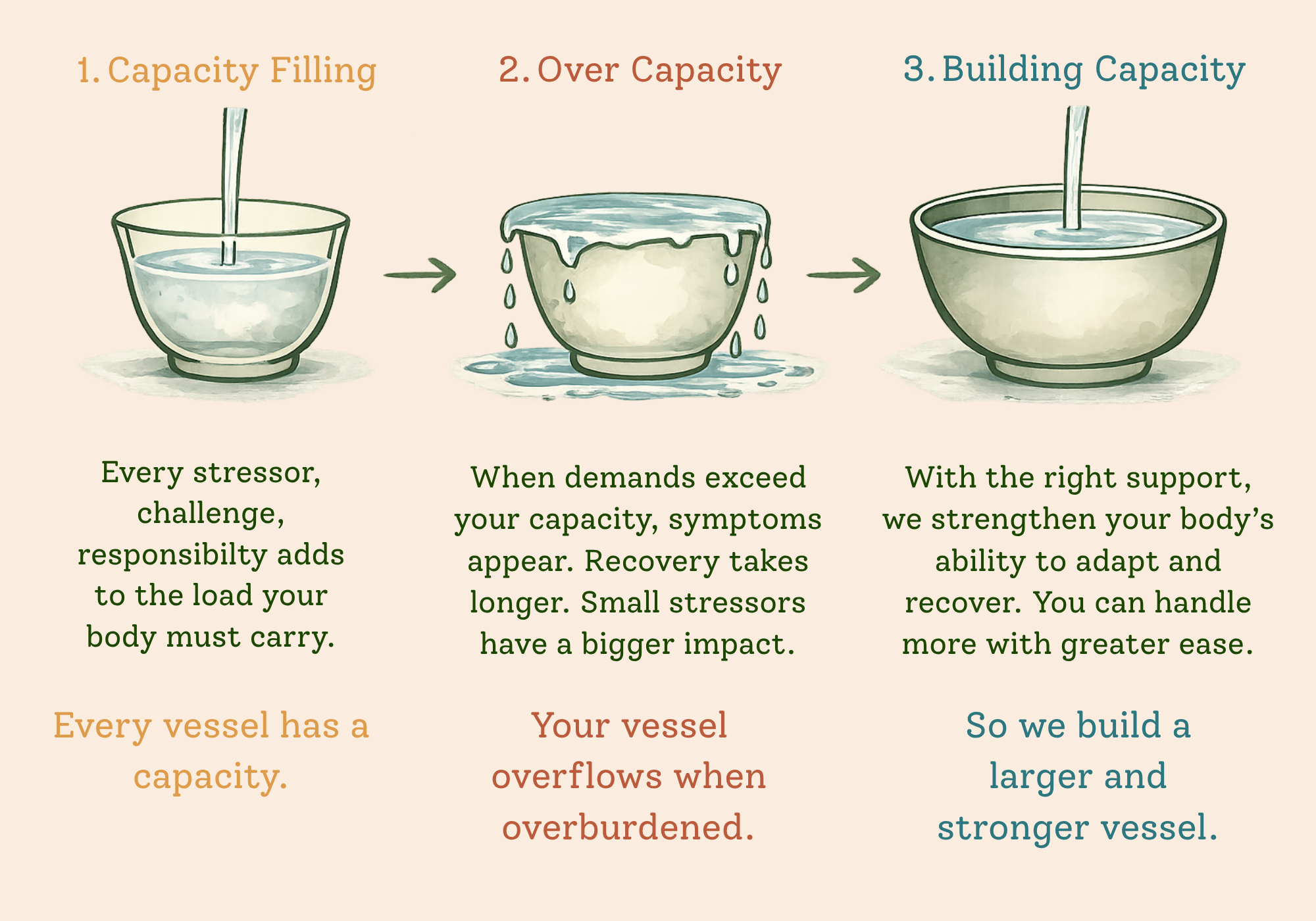
Capacity is the body's ability to respond, recover, and adapt.
When capacity is strong, life still brings challenges, but your body has room to respond.
When capacity becomes overwhelmed, symptoms often become more frequent, more intense, and harder to recover from.
My goal isn't simply to chase symptoms. It's to help restore the body's ability to adapt. That shift changes how I think about every treatment plan I create.

How the Capacity Framework Guides Care
The Capacity Framework isn't a treatment or a diagnostic system. It also isn't a replacement for Chinese medicine or Western medicine. It's the lens that guides my clinical reasoning.
During your consultation, I look at the complete picture:
Your symptoms
Your health history
Your lifestyle
Your stressors
Your recovery patterns
Your body's unique presentation through the lens of Chinese medicine
From there, I prescribe the combination of therapies I believe will best support your health. That may include Chinese herbal medicine, acupuncture, nutrition, lifestyle recommendations, or a combination of approaches.
Every recommendation is personalized and designed around you.
Why Chinese Medicine Fits So Well
One of the reasons I love Chinese medicine is that it has always viewed the body as an interconnected system rather than a collection of unrelated symptoms.
It asks different questions. It looks for patterns. It recognizes that digestion, sleep, emotions, hormones, pain, and energy influence one another.
The Capacity Framework doesn't replace that tradition. It gives me a modern way to explain the same principle to my patients.
Not sure yet? Schedule a free 15-minute call.